AlgoThoughts AI News
Five fresh signals. Five durable tools. No hype tax.
Top 5: New and Worth Your Attention

1. TaskTrooper 0.1.5
TaskTrooper turns a Kanban board into the control plane for role-based coding agents. Tasks move through product, architecture, implementation, review, QA, and release columns while local agent CLI sessions do the work, retain acceptance criteria, and resume after usage limits reset. Its six starter roles, seeded skill library, branch-per-task workflow, and local code index make this unusually complete for a brand-new project—but also much broader than a lightweight task runner.
OPERATIONAL VALUE
Queue a bounded repository change, require review and QA gates, and watch separate specialist agents hand the task forward without manually restarting each session.
QUICK VIDEO
Drop a small bug onto the board, follow it from architecture through implementation and QA, then inspect the generated branch, acceptance verdicts, and pull request.
Reality: TaskTrooper is Apache-2.0 open source and only days old despite a substantial surface. It runs local services, agent CLIs, embedded data, Git operations, browser automation, and optional provider keys, so test it on a disposable repository with least-privilege credentials. Release 0.1.5 publishes macOS, Windows, and Linux builds, but several operational features assume external CLIs, GitHub access, model accounts, or deployment systems whose terms and costs remain separate.
OPEN PRIMARY SOURCE →2. easy-unlocker 2026.09.16
easy-unlocker gives an agent a secret only after a human approves the exact request on a phone. A one-time public key travels with the request; the phone encrypts the value so the broker relays ciphertext and only that command can open it. The CLI can inject a credential into one child process, write a protected file, or request a short-lived SSH certificate—keeping plaintext out of the conversation and ordinary transcript logs.
OPERATIONAL VALUE
Let a coding agent call a provider or diagnostic command without pasting long-lived API keys into chat, shell history, project files, or a shared CI transcript.
QUICK VIDEO
Have an agent request a test API key, show the purpose prompt on Android, approve biometrically, run one command, then confirm the secret never appears in the conversation.
Reality: The CLI, mobile apps, internal libraries, and documentation are Apache-2.0; the broker and Cloudflare Worker are AGPL-3.0. This is a new security-sensitive system, not a password-manager replacement, and project claims are not an independent audit. Android is the most complete path; iOS currently lacks APNs push and requires self-signing. You must operate a broker, protect phone recovery material, and test revocation and failure behavior before trusting production credentials.
OPEN PRIMARY SOURCE →
3. artifact-site 0.1.0
artifact-site is a self-hosted shelf for HTML pages, static builds, PDFs, ZIPs, and office documents produced by different AI tools. Uploads are versioned, searchable, sandboxed, and private until shared; an agent can publish through a skill, CLI, or authenticated remote MCP endpoint. That solves a mundane but persistent handoff problem: turning an agent’s local output into one durable link without scattering artifacts across temporary previews or unrelated SaaS accounts.
OPERATIONAL VALUE
Give every coding assistant one controlled destination for reports, prototypes, and generated documents, with version history and explicit sharing instead of ad hoc attachment workflows.
QUICK VIDEO
Publish a generated static dashboard from the CLI, revise one sentence in the visual editor, compare versions, disable public sharing, and retrieve it through MCP search.
Reality: artifact-site is dual-licensed Apache-2.0 or MIT and has a tagged 0.1.0 release. A local evaluation needs Docker 24+, Compose 2.24+, Git, Make, Bash, and PostgreSQL in the stack; Windows instructions use WSL2. Production deployment adds OIDC, storage, backups, TLS, and policy work. CLI and MCP publishing create a public share by default unless explicitly disabled, so change that behavior before testing sensitive material. Office previews require optional Gotenberg.
OPEN PRIMARY SOURCE →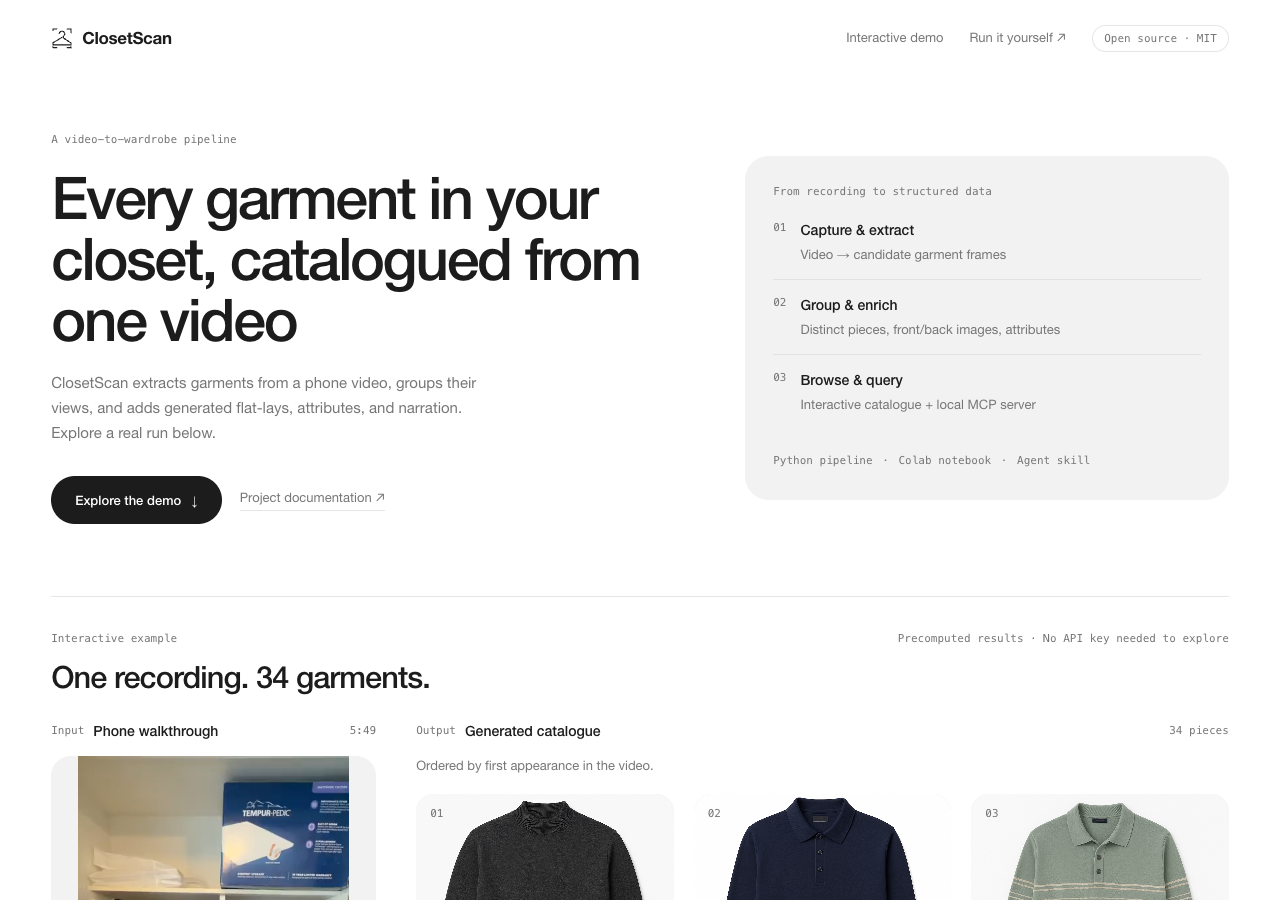
4. ClosetScan 0.1.0
ClosetScan converts one narrated phone walkthrough into a searchable wardrobe catalogue with source frames, attributes, optional generated front-and-back plates, and wear history. A local MCP server exposes seven tools, while the included wardrobe skill lets an assistant answer questions about combinations, forgotten items, or spoken notes. Its strongest design choice is preserving source frames beside generated reconstructions, making it possible to inspect what the pipeline inferred instead of treating synthetic product shots as evidence.
OPERATIONAL VALUE
Turn a personal visual inventory into structured local data that an assistant can query and update, while keeping the original frames available for correction and provenance.
QUICK VIDEO
Film five garments with short spoken notes, process the clip in the notebook, compare source and generated views, then ask which unworn jacket matches one pair of trousers.
Reality: ClosetScan is MIT open source and its MCP server is standard-library Python, but the full pipeline needs Python 3.10+, FFmpeg, model downloads, and careful recording. The free histogram mode tests plumbing rather than recognition quality. DINOv2 runs locally; optional attribute, narration, and product-shot stages send images or text to configured OpenRouter providers and can cost money. Generated plates can be wrong, garment IDs can change after regrouping, and clothing imagery is private data.
OPEN PRIMARY SOURCE →5. Plumloom Autoeval
Plumloom Autoeval packages AI evaluation as a CLI, MCP server, and CI release gate. Teams describe conversations, artifacts, or OpenTelemetry agent traces in files, group them into suites, set overall or per-metric thresholds, and fail a release when results fall short. A read-only doctor command checks authentication, workspace access, enabled models, manifests, and schemas before paid evaluation runs. The approach is useful because reliability evidence sits beside code instead of only inside a dashboard.
OPERATIONAL VALUE
Version evaluation inputs with an application, run the same quality suite after agent changes, and make CI enforce agreed thresholds before deployment rather than relying on spot checks.
QUICK VIDEO
Create one refund-policy transcript evaluation, run doctor, deliberately fail a factuality threshold, fix the prompt, and rerun the suite until the release gate passes.
Reality: The Autoeval client repository is Apache-2.0 open source, but it requires Node 22.13+, pnpm 11 for source builds, a Plumloom account and API key, its hosted API URL, and a connected OpenAI or Together.ai provider. Judge runs therefore carry provider cost and data-handling implications. There is no tagged GitHub release yet, and model-graded evaluation is not objective ground truth; keep human-reviewed fixtures and avoid sending private traces until retention and access controls are understood.
OPEN PRIMARY SOURCE →5 Proven Classics
CopilotKit remains a strong front-end layer for agent chat, generative interfaces, and human-in-the-loop controls. The MIT code is active; connected agent runtimes, models, and hosted services are separate.
Source →Mem0 provides a focused memory layer for agents that need facts to persist across sessions. Its core is Apache-2.0; hosted storage, embeddings, providers, and retained user data require separate review.
Source →Activepieces combines visual automation, integrations, agents, and MCP connections in one approachable system. Community packages are MIT, while enterprise features, cloud service, connectors, and third-party APIs carry separate terms.
Source →LiveKit Agents remains one of the clearest frameworks for realtime voice and multimodal assistants. Its Apache-2.0 code is open source; telephony, transport, speech models, and hosted infrastructure are separate.
Source →Prefect gives Python workflows retries, schedules, state, and observability without forcing agent logic into a bespoke orchestrator. Its Apache-2.0 server is open source; Prefect Cloud has separate terms.
Source →Reality Check
All five featured repositories publish open-source code, but the licenses differ: TaskTrooper and Plumloom Autoeval use Apache-2.0; artifact-site is Apache-2.0 or MIT; ClosetScan is MIT; easy-unlocker uses Apache-2.0 for clients and AGPL-3.0 for broker components. None of those licenses automatically cover connected AI providers, model weights, generated media, hosted services, third-party CLIs, user content, or cloud infrastructure. Four projects are at 0.1 or effectively pre-release maturity, while easy-unlocker handles secrets. Use synthetic data, disposable repositories, pinned versions, minimal permissions, explicit no-share settings, backups, and human review.
Bottom Line
Try artifact-site first if agent outputs keep dying in temporary previews: its local Docker path makes the value easy to judge and the handoff problem is real. TaskTrooper is today’s most ambitious watchlist item, but run it only against a disposable repository until its huge 0.1.5 surface proves trustworthy. ClosetScan has the strongest visual demo. Treat easy-unlocker as a promising security design to evaluate—not yet a reason to move production secrets—and use Plumloom Autoeval only if a hosted, model-graded release gate fits your data policy.
Primary-source research completed September 17, 2026. Private Be Your Evolution field guide.