AlgoThoughts AI News
Five fresh signals. Five durable tools. No hype tax.
Top 5: New and Worth Your Attention
1. Mastermind 2.1.0
Mastermind builds a local, revision-bound code graph so an agent can review consequences beyond the changed lines: callers, architecture boundaries, tests, ownership, security findings, rules, and supporting evidence. Its 2.1.0 release adds bounded role briefs, local concept search, and workflow wiring audits. Jason can point it at one active repository, compare a normal diff review with the graph-backed impact view, and see whether it surfaces a test or downstream dependency the patch alone hides.
OPERATIONAL VALUE
Produces reusable context packets for planner, executor, and auditor roles while keeping source analysis local and tying conclusions to a specific revision.
QUICK VIDEO
Change one shared function, show the ordinary diff, then reveal Mastermind’s impacted callers, boundaries, candidate tests, and evidence packet.
Reality: Mastermind 2.1.0 is MIT open source. The easiest install requires Node.js 24+; a Rust build requires Rust 1.96+. Its release notes say deterministic checks, CI, and package smoke tests passed, but the post-change live Claude evaluation was not rerun because of a spend limit. Treat graph results as review leads, not proof, and verify any suggested impact against code and tests.
OPEN PRIMARY SOURCE →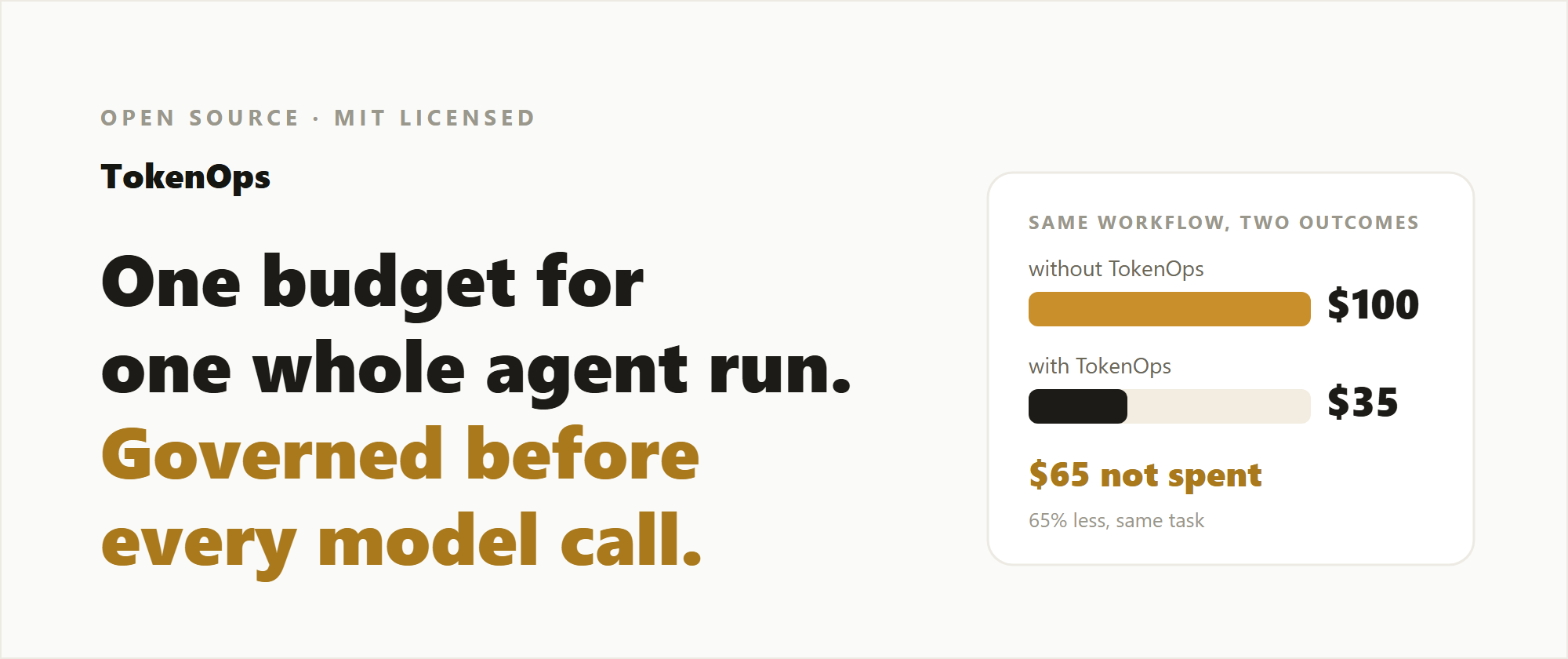
2. TokenOps 0.2.1
TokenOps gives a multi-agent run one shared budget and checks policy before model calls, rather than reporting the bill afterward. Version 0.2.1 improves concurrent policy handling, Windows-safe governance messages, health-check timeouts, and the packaged demo. Jason can run the throwaway local control plane, compare the same bounded workflow with governance off and on, and inspect whether the system steers, compresses, or halts work at a useful point instead of merely cutting it off blindly.
OPERATIONAL VALUE
Adds run-scoped budget visibility and enforceable pre-call controls across multiple agent processes, including tool-call accounting and auditable governance reasons.
QUICK VIDEO
Give two agents one shared budget, run the same task twice, and show the dashboard explaining exactly where governance changed the trajectory.
Reality: TokenOps 0.2.1 is MIT open source and requires Python 3.10+ plus a running control plane; its demo starts a disposable one. Provider pricing, token accounting, and integrations can drift, so validate numbers against actual bills. The project’s savings figures are its own benchmark, not a universal promise. Budget policies can degrade output or stop valuable work when thresholds are poorly chosen, so begin with synthetic tasks and conservative limits.
OPEN PRIMARY SOURCE →3. Gaia Skill Tree 8.8.2
Gaia organizes agent skills as an evidence-backed capability graph rather than a flat marketplace. Release 8.8.2 expands the curated registry, adds checks for product-specific attribution, improves intake and ratification tooling, and publishes bounded runtime projections. Jason can browse the tree without installing anything, trace how one advanced skill builds on simpler capabilities, and use the evidence links as a shortlist for manual review instead of trusting a popularity ranking or copying an unknown skill directly into a live agent.
OPERATIONAL VALUE
Provides a structured discovery and attribution layer for agent skills, with explicit curation, evidence, lineage, rankings, and installability information.
QUICK VIDEO
Start from one basic capability, climb its fusion path to a mature skill, then audit the author, evidence, and repository before installation.
Reality: Gaia’s repository LICENSE contains Apache-2.0, although GitHub currently labels its license metadata “NOASSERTION.” Indexed third-party skills keep their own licenses and risk profiles. The project is maintained primarily by one person, rankings reflect its methodology, and a registry entry is not a security audit. Browse first; if installing the CLI, prefer the documented package route and inspect any remote one-line installer before execution.
OPEN PRIMARY SOURCE →4. Roslyn MCP Server 0.6.1
Roslyn MCP Server exposes compiler-aware C# navigation, analysis, generation, conversion, and refactoring operations to MCP clients, with preview support and solution-wide reference tracking. Today’s 0.6.1 release fixes data-flow regions, expression-bodied analysis, initializer handling, and cross-block control-flow validation. Jason can connect it to a disposable .NET solution, preview one symbol rename or modernization, and compare the proposed change with a text-only agent to see the value of compiler semantics before allowing any write.
OPERATIONAL VALUE
Gives coding agents structured Roslyn operations for C# changes, reducing reliance on fragile search-and-replace while preserving a preview-and-review boundary.
QUICK VIDEO
Ask two agents to rename a public symbol across a solution—one with plain text tools, one with Roslyn—and compare references and build results.
Reality: Version 0.6.1 is MIT open source and requires the .NET 9 SDK or later; Windows troubleshooting may require Visual Studio or Build Tools. The README currently lists 66 tools, but breadth increases the approval surface. Use preview mode, restrict exposed tools, commit or copy the project first, and run builds plus tests afterward. Compiler-valid output can still violate architecture, behavior, API compatibility, or business intent.
OPEN PRIMARY SOURCE →5. ComfyUI Model Resolver 1.2.1
ComfyUI Model Resolver tackles the dullest part of borrowed workflows: finding missing checkpoints, LoRAs, VAEs, upscalers, and related files, then updating paths. Today’s 1.2.1 release opens from ComfyUI’s missing-model overlay, expands current model catalogs, improves Hugging Face and CivitAI matching, and tightens queued-download state and hash handling. Jason can load one broken public workflow, inspect every proposed match and destination, then measure whether resolution replaces an hour of filename detective work without choosing the wrong asset.
OPERATIONAL VALUE
Automates model discovery, fuzzy local matching, download tracking, folder suggestions, hashes, and workflow relinking while keeping the operator in the confirmation loop.
QUICK VIDEO
Open a workflow with three missing models, let Resolver propose sources and folders, verify hashes, then relaunch the graph with every path repaired.
Reality: Version 1.2.1 is MIT open source and needs Python 3.10+ plus ComfyUI; ComfyUI Manager offers the easiest install. Some CivitAI or Hugging Face files need accounts, tokens, accepted terms, or separate licenses, and downloads can be enormous. A matching filename is not permission or safety. Verify publisher, model card, license, hash, disk target, compatibility, and content policy before downloading or redistributing any weight.
OPEN PRIMARY SOURCE →5 Proven Classics
FastMCP remains an Apache-2.0 Python framework for building MCP servers and clients with concise APIs. It is the practical starting point when a useful local capability needs a clean protocol boundary.
Source →Instructor remains an MIT toolkit for validating structured LLM outputs against typed schemas. It is valuable wherever downstream automation needs predictable fields, retries, and explicit parsing failures.
Source →Guidance remains an MIT language for constraining and controlling model generation. It rewards teams that need grammar-level output discipline, though provider support and model behavior still require testing.
Source →Guardrails AI remains an Apache-2.0 framework for validating model inputs and outputs. It helps make failure handling explicit, but validators and policies must be tested against real edge cases.
Source →OpenAI’s MIT Agents SDK remains a compact Python foundation for tools, handoffs, guardrails, sessions, and tracing. It is useful for learning agent patterns without adopting a sprawling orchestration layer.
Source →Reality Check
All five featured codebases use permissive open-source licenses: Mastermind, TokenOps, Roslyn MCP Server, and ComfyUI Model Resolver are MIT; Gaia’s LICENSE contains Apache-2.0 even though GitHub metadata currently reports NOASSERTION. That openness does not transfer to indexed skills, model weights, provider APIs, datasets, or downloaded media. Today’s tools can analyze private code, enforce budgets, install agent capabilities, refactor solutions, and fetch large files. Start on disposable inputs, pin versions, minimize credentials and tool exposure, preview writes, verify hashes, and keep human review plus tests between a plausible result and production.
Bottom Line
Try Mastermind first on a small active repository: it offers immediate evidence about blast radius without uploading the code. If agent cost or runaway delegation is becoming a real concern, run TokenOps’ disposable demo second and judge the intervention points rather than its marketing benchmark. C# work makes Roslyn MCP Server the strongest specialist pick today. Use Gaia as a discovery map, not a trust shortcut, and keep ComfyUI Model Resolver behind deliberate license, hash, destination, and disk-space checks.
Primary-source research completed September 12, 2026. Private Be Your Evolution field guide.