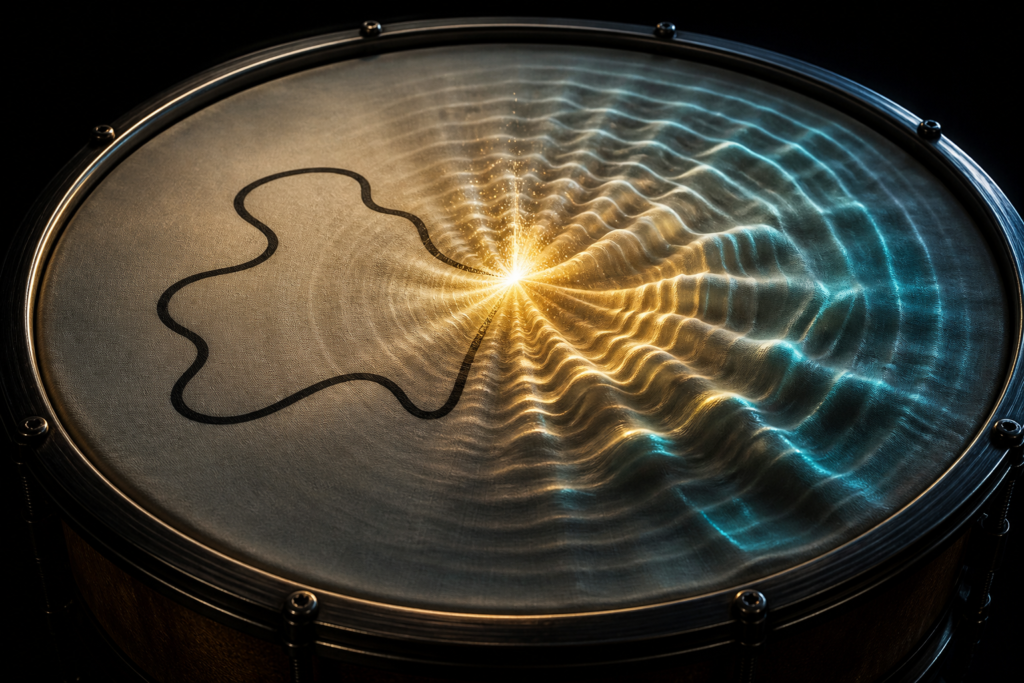
Eigendrum: Draw a Shape, Hear It as a Real Drum
The Idea That Started With a Math Problem
You’ve probably heard the old puzzle: can you hear the shape of a drum? Mathematicians have been asking this for over a century. Now a free browser tool called Eigendrum answers it — and it sounds incredible. Draw anything. Hear what it would actually sound like as a drum. No install, no account, no musical training required. Just open the website and go [S1][S2].
The idea is simple in spirit but rooted in deep mathematics. Eigendrum treats whatever shape you draw as an ideal drumhead clamped at its rim, then solves the Laplacian eigenvalue problem on that exact region using real finite elements [S1][S2]. That sounds intimidating, but the interface hides all the complexity. What you experience is viscerally immediate: you draw a shape, you click it, you hear the sound it would genuinely make.
The tool was created by Basel Ashraf and is published with an MIT open-source license on GitHub, where it has accumulated 158 stars as of August 2026 [S2]. The live version runs entirely in your browser with no backend whatsoever — the meshing, solving, and audio synthesis all happen on your own machine [S1][S2].
What You Can Do in Two Minutes
Grandma-test difficulty: Tier 1 — Instant Click. Zero install, zero account, result in under 60 seconds.
Here is the complete setup walkthrough:
- Open eigendrum.com in Chrome, Edge, or Firefox. The page loads a circular drum plate in the center of the screen with a list of built-in shapes on the side [S1].
- Pick a shape. You can select one of eleven presets including a circle, a five-pointed star, and both halves of the famous isospectral pair — two shapes that sound exactly the same despite looking completely different [S1][S2]. Or draw your own: click and drag on the drum plate to trace any outline.
- Click anywhere on the plate to strike it. The sound plays instantly. Where you click matters: hitting near the rim sounds different from hitting the center, because different parts of the membrane vibrate more or less at each frequency [S1].
- Watch the vibration ripple across your shape. Eigendrum shows the real vibration modes rippling outward from the strike point, with pale channels along the nodal lines — the places where the membrane never moves [S1][S2]. These are the mathematical descendants of the sand figures Ernst Chladni was drawing by hand in 1787.
- Click any row in the mode list to hear just that single eigenfrequency. No physical mallet can strike only one mode at once, but Eigendrum isolates them so you can hear exactly what each frequency contributes to the whole sound [S1][S2].
Try-it time: under 3 minutes from opening the tab to hearing your first drum sound.
Turn It Into a Game or Challenge
Once the circle works, push harder. Try the five-pointed star and notice how the modes organize themselves around the points and valleys differently. Then try drawing a freehand blob — something asymmetric and irregular — and strike it in several places. Listen for how the timbre shifts with each strike.
Here is the challenge that makes people smile: find the nodal line deliberately. Draw a simple shape, strike it near the edge, and notice which mode goes quiet. That is the mode whose standing wave has a node — a point of zero motion — exactly where you struck. You have just heard silence inside sound. It feels almost impossible until you understand why it happens [S1].
Worth your time: absolutely — the first nodal-line discovery is a genuine moment of delight.
The Math Behind the Magic (Optional Rabbit Hole)
If you want to go deeper, Eigendrum rewards curiosity without demanding it. The tool lets you write a shape as a polar equation r(t) or a parametric pair x(t), y(t) where t sweeps one full turn, 0 to 2π radians [S1]. Change one number and hear what moved. The expressions are parsed safely — never evaluated as JavaScript — because a formula arriving from someone else’s shared link is untrusted input that the tool refuses to execute [S1].
The finite element mesh that Eigendrum generates for your shape is displayed and animated alongside the vibration. You can watch the actual triangles the solver uses to approximate your outline flex in real time. For a circle, the first eight modes correspond to Bessel function zeros in mathematically exact ratios. For a star, there are no closed-form solutions — the solver works entirely from the geometry you gave it [S1][S2].
Eigendrum even includes Kac’s famous isospectral drums: two shapes with completely different outlines that share the same set of frequencies. They sound identical even though they look nothing alike. It is one of the most surprising results in twentieth-century mathematics, and now you can hear it in your browser [S1].
One Honest Caveat
Eigendrum requires a modern browser with Web Audio API support — Chrome, Edge, or Firefox work reliably [S1]. Some mobile browsers handle it, but the desktop experience is more reliable. Also, the tool models an ideal drumhead under specific physical assumptions: it assumes the rim is perfectly fixed and the membrane has uniform tension. Real physical drums vary in rim stiffness, head material, and tuning, so Eigendrum gives you the mathematical abstraction, not a physical instrument [S1].
Beyond that, there is nothing to worry about. Your shape never leaves your browser. It lives in the URL fragment, which browsers never send to any server — not even when you share the link. The site logs which page you are on, not what you drew. A local offline clone skips the analytics entirely [S1][S2].
The Bottom Line
Eigendrum is a Tier 1 B.Y.E. project: open a link, draw a shape, hear music — all in under three minutes with zero setup. It passes the Grandma Test on every dimension: no terminal, no install, no jargon, no obscure prerequisite knowledge. Anyone who can draw a circle with a mouse can have a genuinely surprising experience [S1][S2].
Best for: curious beginners, students exploring math or music, hobbyists who enjoy surprising experiments, and anyone who wants a try it tonight project that delivers a real result in minutes
Skip if: you need MIDI export, a mobile-first experience, or want to integrate with a DAW. Those features do not exist yet.
What could make it a waste of time: nothing, for its intended audience. The project is actively maintained — it was pushed today as of this writing — and the barrier to entry is genuinely zero [S2].
Evolve This: Add a simple MIDI export so the isolated drum frequencies can drop directly into a DAW like GarageBand or FL Studio. That one addition would turn a delightful experiment into a production tool.
Sources
- [S1] Eigendrum: Draw a Shape, Hear It as a Real Drum — Basel Ashraf (2026-08-25)
- [S2] GitHub Repository for Eigendrum — Basel Ashraf (2026-08-25)